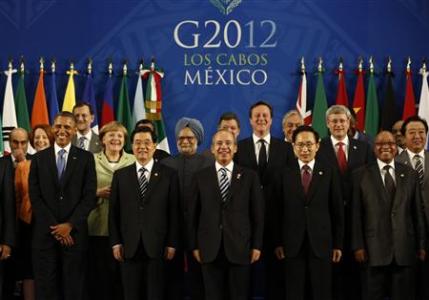
On June 18-19 2012 Mexico is hosting the G20 summit in Los Cabos. The pressing challenge of solving the economic and financial crises will dominate the agenda. Another priority for the summit has also been announced, namely the question of how G20 can play a more significant role in development. In the spirit of the United Nations’ Eighth Millennium Development Goal, which is to develop a global partnership for development, G20 has indicated its willingness to engage in partnerships, including with non-member states and non-state actors.
G20 is composed of the world’s 20 largest economies and is emerging as the premier economic and political forum of key international actors. G20 has embarked on an intense effort to involve actors from the private sector and civil society in its policy-making process to make the organization more horizontal and accountable. For example, a group of 20 think tanks was established, referred to as Think20, to enrich the dialogue between developed and developing countries at G20 with academic input. Although it is a laudable idea to enrich G20’s decision making process with input from researchers, the initiative leaves much to be desired. The arbitrary selection of think tanks, their unequal roles, and the so far inconclusive results make Think20 a far cry from what it claims to be.
First of all, a lack of transparency surrounding the group’s composition undermines the legitimacy of Think20 and the credibility of G20’s intent to make the organization more democratic. Information on how the 20 think tanks were selected is almost impossible to find and it is impossible to deduct clear selection criteria on the basis of the group. The selected think tanks only sometimes score highest in think tank indexes, such as those from the University of Pennsylvania. At first glance, one could think that Think20 was selected on the basis of G20 membership, as most members are represented in Think20 by a country-specific research organization. However, in the February meeting of Think20 some G20 members such as Saudi Arabia or Argentina were not represented, while Singapore, which does not belong in G20, was.
Second, the distribution of roles and responsibilities among the group’s members is unclear. Out of the 20 think tanks, 19 are providing advice and 9 are also involved in organizing. The British think tank Chatham House does not provide input and is exclusively charged with the management of Think20. The organizing and managing think tanks are in fact a club of G20’s advanced economies. This collides with the idea behind G20 to give a voice to emerging and developing economies, perpetuates traditional North-South relations and contributes to the continuous underrepresentation of emerging and developing economies’ interests. A flagrant example of misrepresentation is that the African continent is represented in Think20 by only one regional forum, while the EU is represented by four research institutes. Another example: at Think20’s meeting in February an Indian researcher participated as a second representative from India while he is in fact a researcher at Yale University; consequently, the United States was represented by five institutes.
Third, Think20 yet has to prove its effectiveness and impact on G20 policy. Think20’s formal role is merely advisory. It has to produce a short report with recommendations that will be given to G20 Sherpas to enrich discussions in summits. Afterwards, Think20’s role is to follow up on G20’s commitments and to verify whether they are being accomplished. The results of Think20’s work remain to be seen. Unless its recommendations are effectively turned into policy, Think20 will become a mere façade of G20’s democratization process.
Although having an ensemble of research institutions excelling at independent policy analysis can positively affect the quality and accountability of G20’s decisions, the points above cast doubts over the initiative and raise a number of questions. Shouldn’t Think20 represent academia from all over the world? Shouldn’t procedures be put in place to democratize selection of think tanks and make the group’s composition more transparent? Restricting the voice of the research community to a twenty-member group headed by the advanced economies weakens G20’s own commitment to representation, democratization and global partnership.
G20’s efforts to bring non-state actors into the policy making process could be an effective mechanisms for balanced representation and has the potential to guide policy into the direction of the common good. Think20 could make a difference in making policy more evidence based and less biased towards the West by offering a new platform for research institutes from developing and emerging economies. However, a group of think tanks in which Africa is represented by a only one institution and the EU and US by multiple ones is clearly not the way forward.
Marjolein de Ridder and Paula Sánchez Díaz
Experts
Related Content